Thank you for reading this edition of the Lindahl Letter publication. I’m going to try to get back into the swing of delivering content on a regular schedule. This week the topic under consideration for the Lindahl Letter is, “My Current Coding Setup & The Open-Source AI Shift.”
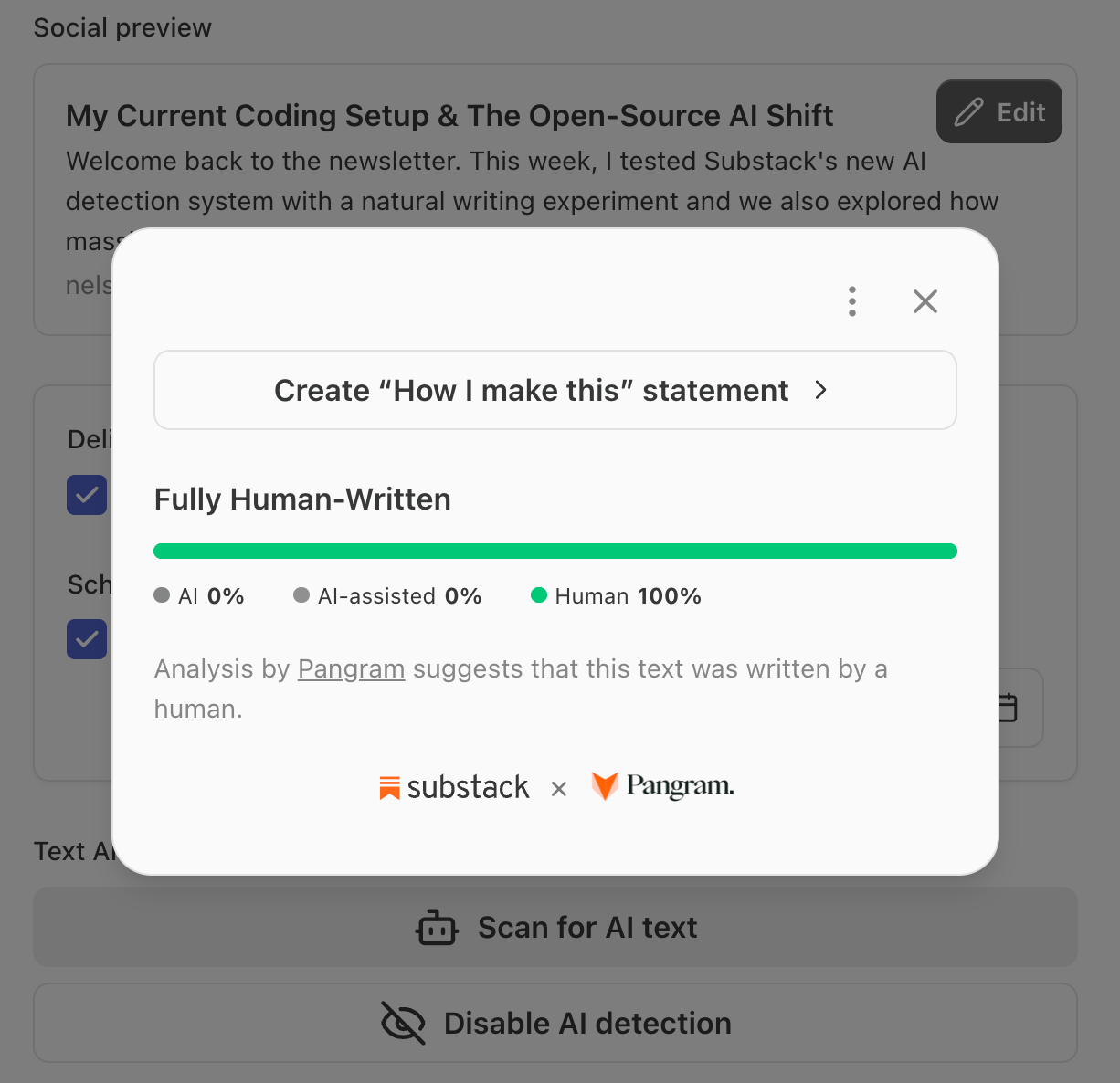
It’s been a hot minute since the last Lindahl Letter arrived on June 7th, 2026. Even the Substack platform has changed a bit since that last missive. They partnered with Pangram to introduce AI SLOP detection in posts [1]. They are making a real push to differentiate organic writing vs. rewarding the SLOP machine. That seems directionally correct. People don’t want to read endless streams of nonsense. Reads can actually test posts with Pangram, but some publishers are opting out of that testing. That got me thinking about writing a post this week and running the detector on my post which I write in Google Docs normally from start to finish in one pass of stream of consciousness. Most of the time I let Gemini or even Pages on my Macbook Air take a swing at checking my grammar and correctness, but this time around I just clicked publish on the post to see if my natural writing style flagged in the system [2]. My online corpus of words is somewhere north of several million words so I was curious what would happen. Welcome to that writing experiment and happy Friday!
Thank you to everybody that checked in on me during that writing downtime. I have just been heads down coding on a cryptographic analysis suite and a high performance knowledge-RAG pipeline. I’m 1,673 Github commits into that cryptographic project to give you an idea of how much progress has been made on that endeavor. Right now I’m targeting using all my Google AI Ultra plan tokens each week in Google’s Antigravity environment. That coding is mostly Python and some Rust. I hit the theoretical limits of the Python language pretty quickly and had to convert a bunch of code into the Rust language for performance reasons. I have Hermes agent from Nous Research installed on my Macbook Air and have been pleasantly surprised at how well it is integrated into the Macbook ecosystem. It is far less impressive in terms of Windows integration. I have even made a couple Hermes skills based on my coding efforts as well which has been interesting.
Right now the big thing people are talking about in the world of AI is the release of some open weight models including Kimi K3 from Moonshot AI and GLM 5.2 from Zhipu AI. Both of those model companies are housed out of Beijing, China and are taking a different path than the frontier labs by publishing the model weights. Kimi K3 is a massive 2.8 trillion-parameter model published in July of 2026. By comparison the GLM 5.2 from June 2026 is only a 744 billion-parameter model and it is fully open-source under an MIT License which is a very popular and highly permissive license for sharing code. I use that license or the Apache one on my repos and it is pretty common for people who just want to share code. The Kimi K3 model is a little different, it is open weight, but it has a custom Kimi K3 license. The big takeaway from both of these models is that if you have the right hardware you can download them and make customizations to run them locally.
The frontier labs like OpenAI and Anthropic keep the weights of the cutting edge models a closely guarded secret. You cannot download and just run the frontier models locally either so people are locked into a model where they are paying for tokens to utilize the cutting edge research. Anthropic has Claude 5 (Opus, Sonnet, and Fable) which I have not really used at this point. The Opus 4.8 model really works well for debugging complex code and it is probably my favorite model at the moment. However, running that model does incur some costs and with Hermes my tokens get consumed very quickly. You really have to be targeted in the things that are worth sending to that model. Choices have to be made or your spending will grow exponentially. Seriously, your prompt engineering has to be strong or you will end up overspending. OpenAI has released the GPT-5.6 family (Sol, Terra, and Luna) which I have not really tried to use at all at this point. Most of my current token spend each week is from that Google AI Ultra plan which includes a lot of Gemini 3.6 Flash and limited Claude Opus/Sonnet 4.6 tokens. I really only kick the tires on Opus 4.8 with the Hermes Portal on a very limited basis.
Consider for a moment that we are at the crossroads of people investing in hardware to use these open weight models locally or trying to figure out the most cost efficient way to buy tokens. In general, people are curious to see if the frontier model companies will continue to be able to charge a premium for access to these models or if commodification will happen based on the strengths of these open weight models being released. The reality of the situation is that most people do not have the hardware to run these models locally so the market for access to tokens will probably normalize to the lowest price models that are effective. We are probably going to hit some point of good enough with the models that the frontier labs will be able to charge for access to the cutting edge tooling, but most people will end up running performant models on dedicated hardware. Probably for most people that will be on their phones running local models and just going out to the cloud for the more complex tasks. A similar situation will probably end up being the case for people using dedicated hardware where most of it will happen locally and when necessary the more expensive models will be called.
Within that scenario most of the model usage will be commodified to the cost of electricity based on access to open-source open-weight models running locally on a desktop or phone, but a percentage of harder tasks will end up going out to the more frontier lab endpoints. That means they will still be able to make money selling tokens, but that market will be much smaller than what we have today. As the next generation of models becomes just good enough to do the basic things people want to do, the need to go out and spend on tokens will probably drop off for people with the ability to run things locally using reasonable hardware builds. We have seen a lot of this demand show up with people buying Apple Mac minis and Apple Mac Studios to run harnessed agents and process workloads. It’s entirely possible that this hardware demand will keep the stock of Apple desktop hardware depleted for the foreseeable future. My guess is even after the Apple team refreshes the chipset in this hardware later this year the supply won’t keep up with demand. They are well positioned to take advantage of this new reality of token economics.
Links I’m sharing this week!
“Bluesky’s new CEO wants a big tent, not a bubble” https://www.theverge.com/podcast/974387/bluesky-toni-schneider-interview-ai-atproto-atmosphere
“A Framework for Frontier AI and the Dawning of a New Age”

“Open Weights and American AI Leadership”
https://images.nvidia.com/pdf/Open-Weights-and-American-AI-Leadership.pdf
“Pacing the frontier”
https://www.pacingthefrontier.com/
What’s next for the Lindahl Letter? New editions arrive every Friday. If you are still reading at this point and enjoyed this content, then please take a moment and share it with a friend. If you are new to the Lindahl Letter, then please consider subscribing. Make sure to stay curious, stay informed, and enjoy the week ahead!
Footnotes:
[1] https://support.substack.com/hc/en-us/articles/50891130623508-How-can-I-detect-AI-on-Substack
[2] This post was rated 100% human by the Pangram scan ;) you can check that yourself in Substack now which is interesting.